Grip, Gait, and the Numbers Your Doctor Isn't Measuring: The Hidden Vital Signs of How You'll Age
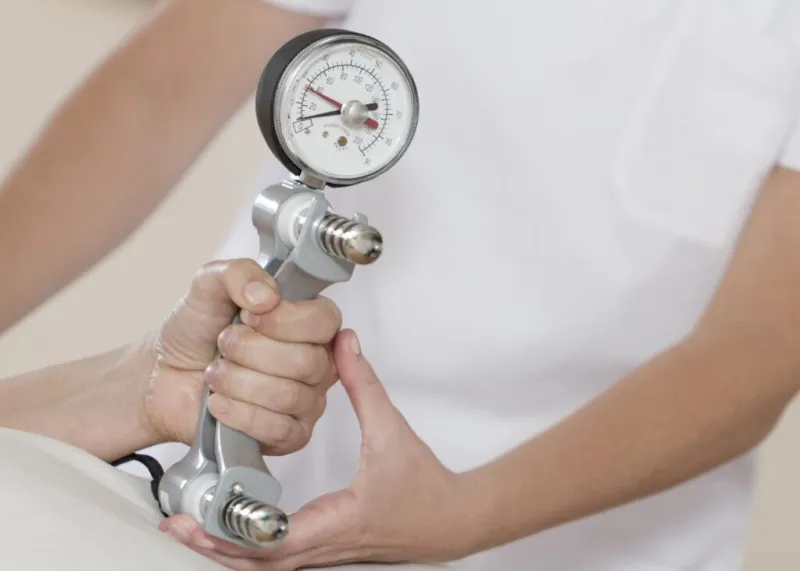
Photo: older adult testing grip strength with hand dynamometer in clinic, via moyerwellness.com
Every year, millions of Americans dutifully roll up a sleeve for the blood pressure cuff and fast overnight for the lipid panel. These numbers matter. But according to geriatricians, two of the most powerful predictors of future health rarely appear on any lab slip: how hard you can squeeze and how quickly you walk.
Researchers call grip strength and gait speed the "vital signs of aging" for good reason. Large population studies, including data from the long-running Framingham Heart Study, have linked weaker grip and slower walking pace to higher risks of disability, hospitalization, cognitive decline, and earlier mortality — often decades before symptoms appear.
Why Muscle Is a Health Savings Account
Sarcopenia — the age-related loss of muscle mass and strength — begins quietly. Adults can lose 3 to 8 percent of muscle mass per decade after age 30, and the decline accelerates after 60. Because muscle drives metabolism, mobility, and even immune function, letting it erode is like draining a retirement account one untracked withdrawal at a time.
The encouraging news: muscle responds to resistance training at virtually any age, and studies show structured strength programs can reverse sarcopenia even in adults in their 80s. The earlier you start, the larger your reserve.
The Five-Minute Home Assessment
You don't need a clinic to benchmark yourself. Try these evidence-informed self-tests:
Grip strength (the towel test): While a dynamometer gives a precise reading, a practical proxy is a firm dead hang from a pull-up bar or wringing a wet towel with full effort. Clinically, grip below roughly 26 kg (57 lbs) for men and 16 kg (35 lbs) for women suggests low muscle strength worth discussing with a physician.
Gait speed (the 4-meter test): Mark a 13-foot (4-meter) stretch of hallway or sidewalk. Walk it at your normal, comfortable pace — not a stroll, not a race — and time it. Faster than one meter per second (about 3.3 feet per second) is generally favorable. If it takes noticeably longer than 4 seconds, or you've recently slowed without trying, flag it.
The chair stand: Sit in a sturdy chair, arms crossed over your chest, and stand up five times as quickly as you safely can. Times over roughly 12–15 seconds for older adults suggest lower-body weakness.
Repeat these annually, on your birthday, and track the trend rather than any single result.
What Actually Rebuilds Muscle
Walking alone, while valuable for cardiovascular health, is not enough to preserve strength. The evidence points to a two-part prescription:
1. Resistance training, twice weekly. The CDC and the second edition of the Physical Activity Guidelines for Americans recommend muscle-strengthening activity on at least two days per week. That can mean dumbbells, resistance bands, bodyweight squats and push-ups, or a beginner class at a local YMCA. Aim for movements that challenge the major muscle groups — legs, hips, back, chest, shoulders — in sets of 8 to 12 repetitions.
2. Adequate protein. Many older adults, and plenty of busy 40-somethings, under-consume protein. Most research supports roughly 1.0 to 1.2 grams per kilogram of body weight daily for active adults, distributed across meals. A 160-pound person should target somewhere near 75–90 grams per day — think eggs at breakfast, beans or poultry at lunch, fish or lean beef at dinner.
Consistency beats intensity. Two moderate sessions every week for a year will outperform a heroic January that ends by Valentine's Day.
Bringing It Up at Your Next Physical
Don't wait for your physician to volunteer these measurements — many practices don't routinely perform them. Ask directly: "Can we check my grip strength or gait speed today, and what should my targets be for my age?" A growing number of primary care and physical therapy offices keep a hand dynamometer on hand, and Medicare's Annual Wellness Visit is a natural opening for the conversation.
If your numbers are already low, a referral to physical therapy can provide a tailored, supervised program — often covered by insurance when medically indicated.
The Bottom Line
Your annual labs paint a picture of your chemistry. Grip strength and gait speed paint a picture of your future function. Both belong in your prevention toolkit, and the second pair costs nothing to measure at home. Pick a birthday, pick a hallway, and start tracking — your 80-year-old self is keeping score.